Secondary Curriculum
Welcome
Welcome to the Climate Innovation Challenge (CIC)! CIC is a Science, Technology, Engineering, Arts, and Mathematics (STEAM) education program developed by nonprofit Climate Advocates Voces Unidas (CAVU). CAVU inspires local solutions to the climate crisis via visual storytelling and youth education programs.
CIC was born out of the understanding that the climate crisis is the defining challenge for today’s youth, impacting their environment, health, culture, and future job prospects. The CIC program includes a free six lesson science and storytelling curriculum that cultivates student leaders who can think innovatively and communicate effectively about adapting to our changing climate.
We challenge students to create locally-led, culturally-responsive solutions that build resilience in their own communities. Students are asked to follow a scientific process to complete their projects, and they are challenged to use their creative minds to communicate these designs in exciting and engaging ways. After students go through this process, they create a short (4-minute max) video to showcase their proposed solutions. Students can submit their short films to our annual competition, where cash prizes are awarded for outstanding student work.
At its core, the CIC is an undertaking in storytelling. We better understand the impacts on people and how to protect their environment if we listen to their stories. Stories are compelling, and they connect us together in a world that has become too divisive. Once finished, participating students will have created a video presenting their concept that they can easily share with peers, public and private sector businesses, community leaders, environmental stewards, and more.
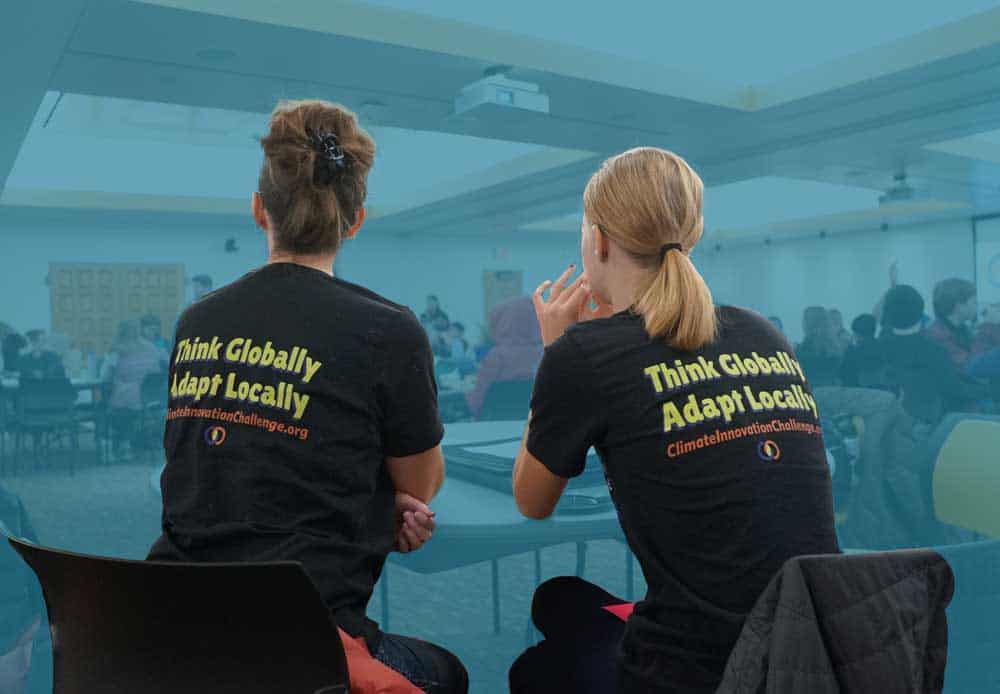
We encourage students to “think globally and adapt locally,” fostering solutions-driven thinking for their own communities.
Table of Contents
Orientation
- Curriculum
- CAVU’s Commitment to the Land and Original Peoples
- Additional Resources on Indigenous Approaches to Climate
- Resources for Navigating the Heaviness of Climate Change
- Project Format
- Project Submission & Media Release
- Judging Process Student Showcase & Prizes Challenge Project Criteria
Lesson 1: Find Your Entry Point
- Opening Hook: What Would You Change? (5–10 minutes)
- Climate Change Overview (25 minutes)
- Introduce the Climate Innovation Challenge (5 minutes)
- Mind Mapping Activity (15 minutes)
- Finding My Entry Point (20 minutes)
- Wrap-Up: Closing Share/Reflection (5 minutes)
- Optional Resources: Diving Deeper into Climate Change
Lesson 2: Investigating Local Climate Impacts
- Opening Hook: Forecasting our Future (5 minutes)
- Local Climate Inquiry (40 minutes)
- Connect Issues to Entry Points (10 minutes)
- Optional Activity: Climate Equity Scenario (15 minutes)
- Community Vulnerabilities Group Activity (20 minutes)
- Wrap-Up: Define a Climate Problem & Research Questions (10 minutes)
Lesson 3: Brainstorming Climate Change Solutions
- Climate Change Justice and an Interconnected World View (20 minutes)
- Brainstorming Your Solutions (20 minutes)
- Mind Map Activity
- Project Assessment (20 minutes)
Lesson 4: Reputable Research
- Climate Change Justice and an Interconnected World View (20 minutes)
- Brainstorming Your Solutions (20 minutes)
- Mind Map Activity
- Project Assessment (20 minutes)
Lesson 5: Climate Messaging & Project Design
- Hook: Persuasion (5 minutes)
- Storytelling Techniques (30 mins)
- Climate Action Plan (25 minutes)
- Pre-Production – Scripts and Storyboards (40 minutes +)
Lesson 6: Video Production
- Day 1: Video Analysis & Intro to Canva
- Hook: CIC From a Judge’s Lens (5 minutes)
- CIC Judging Criteria Analysis Using Winning Videos (30 minutes)
- Optional: Take a Test Drive with Canva Pro (40 Minutes)
- Wrap-Up: Sharing & Canva Takeaways (5 minutes)
- Day 2-4: Video Production!
- Hook: Video Editing Tips & Tricks (15 minutes)
- Video Production Work Time (2-3 class periods)
- Optional: CIC Judging Criteria Self/Peer Analysis (20 minutes)
- Submission Instructions
- Next Steps
Orientation
Curriculum
In the Climate Innovation Challenge (CIC), students from around the world create solutions that build climate resilience in their own communities and present their ideas in short videos. We believe in starting where you are, in students’ physical location, cultural location, world view location, and as individuals with the strengths and interests each student brings to the table.
The CIC curriculum is made up of six thematic lessons. Please note that some lessons may take longer depending on which videos you choose to view with your class. We’ve listed running times so that you can time your lessons appropriately. Lesson 6 is more extensive and may take up to four or five 60-minute class periods to complete.
Each lesson consists of the following sections:
- Learning Outcomes
- Essential Questions
- Teacher Notes
- Classroom Discussion and Activities
- NGSS and ELA Standards Met
- Lesson Handouts and Additional Resources
The flexible curriculum allows teachers to spend one hour on a lesson or several days on topics. The curriculum is designed to meet Next Generation Science Standards (NGSS) and English Language Arts (ELA) Common Core standards for middle school students. Built-in flexibly allows it to serve elementary and high school students. Lessons include:
- Lesson 1 – Find Your Entry Point
- Lesson 2 – Mitigation & Adaptation Strategies
- Lesson 3 – Brainstorming Climate Solutions
- Lesson 4 – Reputable Research
- Lesson 5 – Climate Messaging & Project Design
- Lesson 6 – Video Production
CAVU’s Commitment to the Land and Original Peoples
Because we believe in starting out where you are, we seek to work in solidarity with the communities who have been most deeply impacted by the systems responsible for creating climate injustice. CAVU acknowledges that our organization’s work is situated within a long history of climate resilience work, and we honor that legacy. The original peoples of lands across the world have understood and acted in ways that center care for the land, and we see it as a core responsibility to use our platform to amplify these longstanding relationships between Native peoples and their lands in North America, Africa, Asia, and across the world. As a result, you will see examples from and references to Indigenous communities throughout the curriculum.
That said, we encourage teachers and students to shape their approach to the curriculum based on their own sets of relationships with the land and their own world views. While we have a long way to go before our collective work has made the impacts we are hoping for, we remain strong in our belief that we must begin where we are, with what we can touch. Our commitment to our local and global communities is at the heart of our work, and we are grateful you have trusted us with the opportunity to work, learn, and relate with you and your students.
Resources for Navigating the Heaviness of Climate Change
For educators and students alike, focusing on climate change can come with a multitude of emotions. Climate change is a global issue, and much of the conversations we see are problem-focused and not solution-focused. It’s completely normal to have moments of feeling overwhelmed, but there are resources that can help remind us that we are not alone in this experience and refocus us on climate solutions. Below we have a list of resources to help manage eco-anxiety:
We have found that creating a brave, trustworthy space for students to engage in is a foundational element of this process. We hope these resources can be of use for creating that space. Please use as much or as little as you feel appropriate for your classroom, and always know that we are here to help if you have any questions.
Project Format
CAVU staff members are available to work with students and teachers to create engaging videos to showcase student ideas. Often, students will use presentation software as the foundation for creating a project. While we accept student work in a variety of file formats, we encourage the use of Canva Pro as a means for producing CIC projects. Educators can register as a verified Canva educator here. You and your students should be given access to Canva Pro for FREE once verified. Click here for a video tutorial on how to incorporate Canva Pro for educators in your classroom. Be sure to register early on in the process so that you can gain access to the software and set up your online classroom before students start to use the program. Here are some suggestions if your students would like to use presentation software for their project.
Project Submission & Media Release
To submit to the Climate Innovation Challenge, minors (under 18 years of age) are required to have a media release form signed by a parent or guardian. This can electronically or via a printed PDF that would need to be scanned and returned to CAVU staff.
When a project is completed, students are encouraged to upload their video to the Climate Innovation Challenge on FilmFreeway. Student work will be evaluated for the Showcase on their ability to present a sound solution and tell an engaging visual story about their solution. All projects must be pre-recorded and submitted as a standard video file. For more information about how to submit to this year’s competition, visit us online at cavu.org.
Judging Process
Once projects are submitted, a preliminary panel of judges will evaluate submissions that meet the project criteria via the CIC Judging Rubric. Judges will look for projects that meet the project criteria and excel in many of the categories included in the rubric. Top scoring projects will be moved onto Round 2 judging to determine which projects will receive our top awards.
Student Showcase & Prizes
Award winning entries will be honored in CAVU’s annual Climate Innovation Challenge Student Showcase. This virtual event is held at the end of the school year to highlight students’ achievements and present awards. Visit cavu.org to learn more about this year’s showcase and prizes. Winning videos will be listed publicly on CAVU’s YouTube channel.
Challenge Project Criteria
For challenge participants, the following criteria serve as a baseline for what is expected to qualify for the CIC Student Showcase. Participants can work individually or in groups. The size of the group is unlimited.
For strong projects we recommend that they:
- Be pre-recorded and submitted as a standard video file. (DV, MPEG-4, MP4, MPEG-2, MOV, and M4V are all acceptable formats). – Mandatory
- Not exceed 4 minutes in length.- Mandatory
- Display a climate change solution.
- Be subtitled in English.
- Not use copyrighted music, graphics or materials that may cause them to be flagged on streaming services.
- Cite at least three sources in a format chosen by the educator.
- Contain an opening title containing all participants’’ first names, grades, instructor names (if applicable), and school/institution name.
- NOT include their last names on their submissions for privacy reasons. CAVU accepts no responsibility or liability for participants’ failure to adhere to this guideline.
Please note that this is a video competition. Essays, research papers, and slide presentations will not be accepted.