
Lesson 4: Brainstorming Climate Change Solutions
Table of Contents
Learning Outcomes
- Brainstorm adaptation and mitigation solutions for their CIC project.
- Listen to various perspectives on climate change to help formulate meaningful and equitable solutions.
- Cultivate a holistic view of climate change and its far-reaching impact on different aspects of their daily lives.
Essential Questions
Why did you choose this particular climate change problem? How does it connect to you, your family, or your community?
How does listening to the stories and voices of our youth and Elders inspire you?
Can you tell an engaging story about the climate solution ideas you are exploring?
Does your solution take into consideration climate justice for those who suffer from disproportionate climate change impacts?
What are some possible resources that you may want to tap into for your project?
Notes to Teacher
Handouts
Classroom Discussion & Activities
Brainstorming Your Solutions (20 minutes)
- One approach is to encourage the learners to think locally, look around their immediate environment and community. Encourage your learners to think of the smallest intervention possible that if adopted on a wider scale would be effective. For example:
- If school leadership provided incentives to learners to walk, bike, or take public transportation to and from school, they might do so more often.
- If neighbours saved seeds from their backyard gardens, you could create a community seed bank of locally adapted seeds to support future, resilient gardens.
- The First Lady is introducing fruit gardens in schools to promote climate resilience as well as provide healthy fruits to the learners.
- There is a low cost high impact local intervention for the ban of single use plastic in Kenya, by the former Cabinet Secretary for Environment Professor Judy Wakhungu.
Mind Map Activity
A mind map is a great way for students to brainstorm climate change solutions and impacts for their entry point. As a systems thinking tool, students can quickly organize their thoughts and ideas around climate change while making connections between cause and effect, potential solutions, stakeholders, and community impacts.
- This activity can be done as an entire class or individually.
- Use a piece of paper.
- Learners should start by drawing or typing their climate change problem or solution in the middle of the paper.
- Next, learners can continue to add key ideas, techniques, structures, dream concepts, solutions, causes, and components of the system as branches that seem to be related to their main idea or topic
- As ideas come to mind, learners can add more branches and concepts that spread throughout the page.
- Adding colour and images can help inspire creativity and critical thinking.
- Free online mind map options – Canva (bit.ly/CAVU-Canva), Coggle (bit.ly/CAVU-Coggle), Mindmup (bit.ly/CAVU-Mind), bubbl.us
Follow up question for learners:
- How do you take this web of ideas and formulate a specific solution to address climate change in your community?
- Encourage the learners to share their proposed solutions either individually or in groups.
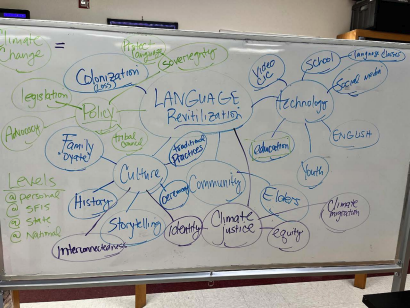
Click to enlarge the mind map example from Santa Fe Indian School 9th graders around language revitalization as an entry point for climate change.
Climate Change Justice and an Interconnected World View (20 minutes)
- Watch Definition of Climate Justice (3:21) (bit.ly/CAVU-Justice)
- An essential component of climate justice is the understanding of the interconnectedness of environmental issues with numerous aspects of our lives. Beyond the environment, climate change impacts health, mental wellness, culture, identity, and community.
- Watch Climate change is impacting coffee growers (4:13). This video tells the story of the economic impacts climate change has on communities.
- Indigenous perspectives take climate justice and extend them beyond the human realm, focusing on the interconnectedness of all beings.
- Listening to our Youth and Elders
- Watch Indigenous activists on tackling the climate crisis (5:00) (bit.ly/CAVU-Indigenous-Activists)
- Watch “Powerful Speech From A Young Ugandan Climate Activist” (bit.ly/CAVU-Speech) Hilda Flavia Nakabuye of Fridays for Future Uganda (3:59)
- Watch Ewi Lamma’s story as a youth climate activist from Cameroon “African Voices for Africa’s Forests- Gender, Indigenous Rights, and Restoration” (9:02) (bit.ly/CAVU-African-Voices)
- Watch A Climate Ambassador from Uganda Vannesa Nakate (uni.cf/3U4M0WL, bit.ly/CAVU-UN)
- Discussion questions:
-
- How did the work of young climate activists resonate with your own interests in climate justice and action?
- As a young person, do you feel like you can make a difference in climate change?
- Can you identify the name of the young Ugandan Climate Activist?
-
- Listening to our Youth and Elders
Project Assessment (20 minutes)
- Using their mind map, work with the learners to identify one solution that resonates with them. Then, recommend the following checklist to the learners to help them assess the feasibility and effectiveness of their proposed solution.
- Learners can discuss as pairs or in groups.
- Would it be expensive? Think about the cost vs. the benefit.
- Is it even possible? What tools, skills, and resources would you need?
- Does it address the root of the problem?
- How long would it take to complete? Is it a short-term or long-term solution?
- Does the idea conflict with or support community values and traditional practices?
- Does your solution address climate justice concerns?
Freewrite Exercise
Triangulating Your Action Point
- What is your inspiration?
- Who do you want to inspire with my stories?
- What changes do I want to inspire with my work?
- What is your desired impact?
- Who do I want to impact first?
- Where do my (hi)stories meet with my passions and talents?
- What are your available resources?
- What resources do I have available to me right now?
- How do my available resources differ from others?
- How can I take action to address climate change based on where my inspiration, desired impact, and available resources intersect?
Have learners share what they experienced during this exercise with the class if time allows. It may be encouraging to allow learners to provide feedback and support to one another before they move from this point to the production process.